Rootamental needs a smart car to visit the shops and distribute our skateboards. Turns out a friend is hooking us up with the radest1984 Mercedes-Benz 300TD wagon turbo diesel. My first car was a wagon I knew then that was the perfect car. The Diesel is good form of ECO transportation using Bio-Diesel. “Biodiesel is a cleaner-burning, renewable fuel that is non-toxic, biodegradable, and can be run in any standard diesel engine without modifications. It has better emissions, and only a slight loss in power when compared to regular diesel. When considering biodiesel for your vehicle, you must look at where your nearest biodiesel station is. This website: http://www.biodiesel.org/buyingbiodiesel/retailfuelingsites/ will help you find out where your nearest retailer is.” David Pascale President, Cal Poly Biodiesel dpascale@calpoly.edu
In the evening of 29 September 1913, Diesel boarded the post office steamer Dresden in Antwerp on his way to a meeting of the Consolidated Diesel Manufacturing company in London. He took dinner on board the ship and then retired to his cabin at about 10 p.m., leaving word for him to be called the next morning at 6:15 a.m.. He was never seen alive again. Ten days later, the crew of the Dutch boat Coertsen came upon the corpse of a man floating in the sea. The body was in such an advanced state of decomposition that they did not bring it aboard. Instead, the crew retrieved personal items (pill case, wallet, pocket knife, eyeglass case) from the clothing of the dead man, and returned the body to the sea. On 13 October these items were identified by Rudolf’s son, Eugen Diesel, as belonging to his father.
Rootamental is about Design; designing a better way to build a new world of sustainable health and beauty~~ By learning from nature.
Michael Pawlyn describes three habits of nature that could transform architecture and society: radical resource efficiency, closed loops, and drawing energy from the sun.
Why you should listen to him:
Michael Pawlyn established the architecture firm Exploration in 2007 to focus on environmentally sustainable projects that take their inspiration from nature.
Prior to setting up the company, Pawlyn worked with the firm Grimshaw for ten years and was central to the team that radically re-invented horticultural architecture for the Eden Project. He was responsible for leading the design of the Warm Temperate and Humid Tropics Biomes and the subsequent phases that included proposals for a third Biome for plants from dry tropical regions. In 1999 he was one of five winners in A Car-free London, an ideas competition for strategic solutions to the capital’s future transport needs and new possibilities for urban spaces. In September 2003 he joined an intensive course in nature-inspired design at Schumacher College, run by Amory Lovins and Janine Benyus.
Watch this video and let your friends know what you think about Rootamental Design.
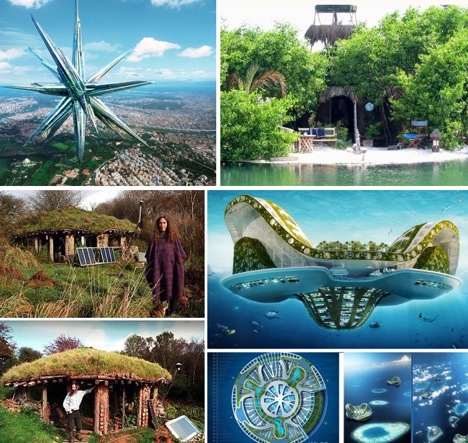
Ecovillages (or eco-villages) are communities with a strong ecological focus. An ecovillage might be urban, suburban, or rural and they can range in size from a few to hundreds. Some eco villages are attempts to shift existing neighborhoods or towns toward more sustaainable living and more of a sense of community. Others are newly built, often featuring green or natural building techniques. Ecovillages vary a lot in their degree of community connection and their ecological focus. See also: The Global Ecovillage Network’s Ecovillage Directory
What is an EcoVillage?
“The EcoVillage is a prototype of future sustainable living communities with a goal of implementing alternative social and ecological standards.In 1991, Robert Gilman set out a definition of an ecovillage that was to become a standard. Gilman defined an ecovillage as a human-scale full-featured settlement in which human activities are harmlessly integrated into the natural world in a way that is supportive of healthy human development, and can be successfully continued into the indefinite future. Gilman’s definition gives a basic idea – yet what does one look like and how do the people in the community live and interact with the world around them? In order to answer these questions we need to look at a little history…Before our modern societies were fashioned in the way they were people lived in small village type communities. It took centuries to bring about the huge cities and neighborhoods that we are familiar with. During the late 60’s and 70’s there was a “back to the land” or “commune” movement that had varying degrees of success and significant failures that contributed to the collective data base we can now tap into when asking the above questions. Many of those communities had a magnetic leader that promised to lead the way to utopia. Due to the well publicized accounts of the failures of these communes many people in our society have developed what can be called a “3C” association – Community=Commune=Cult equation when they hear about intentional communities. What we hope to bring forward is more information that will hopefully help dispel of this negative image/stereotypes and bring us all up to speed about the actual evolution that has occurred from learning from past mistakes.” ~ from ‘EcoVillage’ Interdependent Project
And what is an urban EcoVillage?
The urban EcoVillage is an emerging community phenomena that is sometimes planned but mostly an organic coming together of people in urban neighborhoods and densely populated areas.
The LA EcoVillage is a project where urban EcoVillagers demonstrate the processes for creating a healthy neighborhood ecologically, socially, and economically. The strategy is to reduce environmental impacts while raising the quality of neighborhood life. ____________________
Ecocity Builders is an organization working to reshape cities for the long-term health of human and natural systems They develop and implement policy, design and educational tools and strategies to build thriving urban centers based on “access by proximity” and to reverse patterns of sprawl and excessive consumption.Ecocity Builders and associates’ definition of “ecocity” is conditional upon a healthy relationship of the city’s parts and functions, similar to the relationship of organs in living complex organism. They are concerned with city design, planning, building, and operations in an integral way and in relation to the surrounding environment and natural resources of the region, utilizing organic, ecological and whole-systems lessons to actually reverse the negative impacts of climate change, species extinction and the destruction of the biosphere.Ecocity Builders believe the form of the city matters, that it is within our ability, and indeed crucial, to reshape and restructure cities to address global environmental challenges.



 Rootamental