The Pericú are best known for their maritime orientation, harvesting fish, shellfish, and marine mammals from the waters of the southern Gulf of California. Terrestrial resources such as agave, the fruit of cacti, small game, and deer were also important. Agriculture was not practiced.
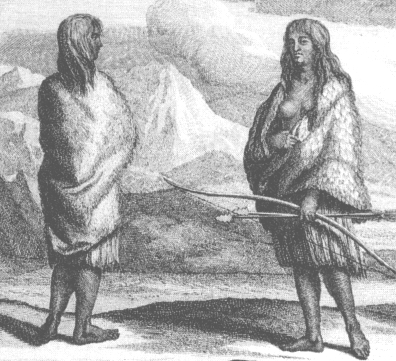
The Pericú were one of the few aboriginal groups on the California coasts to possess watercraft other than tule balsas, making use of wooden rafts and double-bladed paddles. Nets, spears or harpoons, darts, and bows and arrows were tools for procuring fish and meat. Bags, baskets, and gourds were used for carrying, since pottery was not made. The requirements for shelter and clothing were minimal, although the women wore skirts of fiber or animal skins and both sexes adopted various forms of adornment.
Click Title for MORE…
For decades, archaeologists, anthropologists and scientists have supported theories that indicate that the first colonizers migrated to our continent about 12,000 years ago. A new project, however, is being developed between the Natural Environment Research Council of England and the Instituto Nacional de Antropologia (National Institute of Anthropology) in Mexico, has produced amazing results, indicating high probabilities of America being populated several thousands of years before the last Ice Age, about 30,000 years ago. This knowledge has been kept by an indigenous tribe, known as the Pericu, that used to inhabit the Baja California region in Mexico and vanished more than 200 years ago.
Until recently, the general belief was that the continent was populated by Siberians who came to North America across the Bering. The findings of the analysis of Pericu skulls indicate that these aborigines were not descendants of the Siberians since their skulls are long and narrow while the main characteristics of a Siberian skull are known its roundness and broadness. The Pericu skulls are more like those of the aborigines, native to Southeast Asia and the Pacific. Thanks to these results, now the theory is that the Pericu Tribe may have gotten to America’s western coast navigating from island to island in canoes, parting from Polynesia and Asia, in times when the sea level was lower.
Experts say that this new theory, far from ruling out the one about the Bering Strait, completes it. The goal here is not to establish only one migratory route towards the colonization of our continent but to find out how many took place, what was the route, how long it took and which groups did it.
Further study of the Pericu Tribe will probably give a wider perspective as well as a better idea of the way our continent was populated and how its first inhabitants used to live. So far, we know they were fishermen, hunters and seed and root gatherers. They had nomadic tendencies and they extended their territories from Cabo San Lucas to the center of the peninsula (parallel 24), including the islands of Espiritu Santo and San Jose. It is also known that they used the bow and arrow and the blowgun, practiced polygamy and lived in caves.
All along the dessert territories of Baja California, over 200 archaeological sites and gigantic caves with amazing rock paintings have been found. They are still being studied to try to discover all of the secrets they have kept during their probable 30,000 years of existence.
If you are in Los Cabos on vacation, do not miss the chance to visit these extraordinary places. Learn about a culture that has hundreds of years of history under its belt, as well as the heritage of a tribe that might have been the first to step onto the continent.